The Structure of Claim by Jasmin Werner is the first exhibition in the series for fear of continuity problems. It examines memory and remembrance in the poster frames outside the GAK and in part of the indoor space. We have invited six artists to take turns discussing these concepts in their works in a variety of ways.
In her sculptures and installations, Jasmin Werner explores transnational movements and investigates the ways in which these are represented in structures such as architecture. The power that spaces, buildings, and facades exert over the present and memory is intersected with images and narratives of things that are otherwise often excluded. In The Structure of Claim, for example, the artist interweaves supposed truths and values with the realities of life in the diaspora.
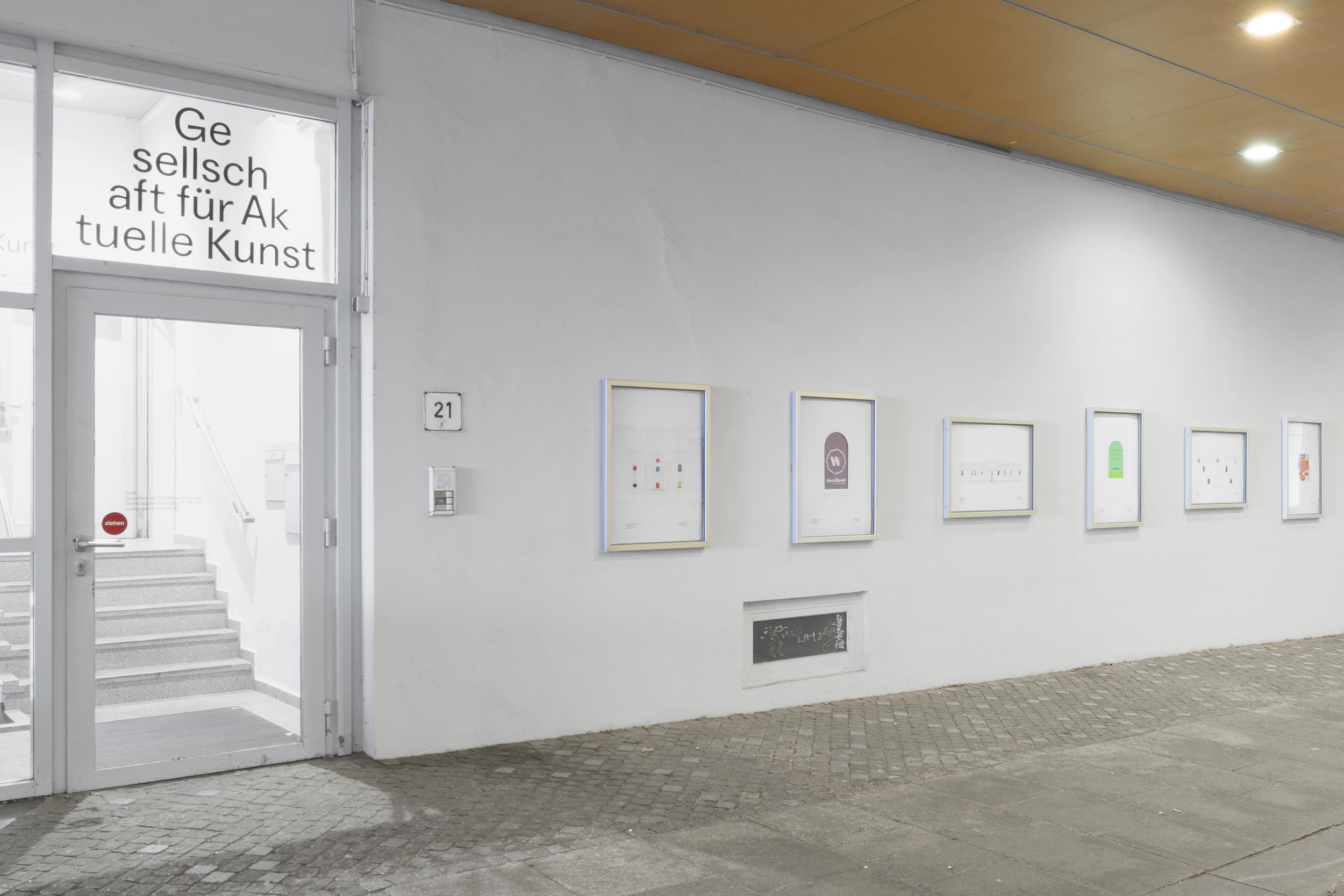
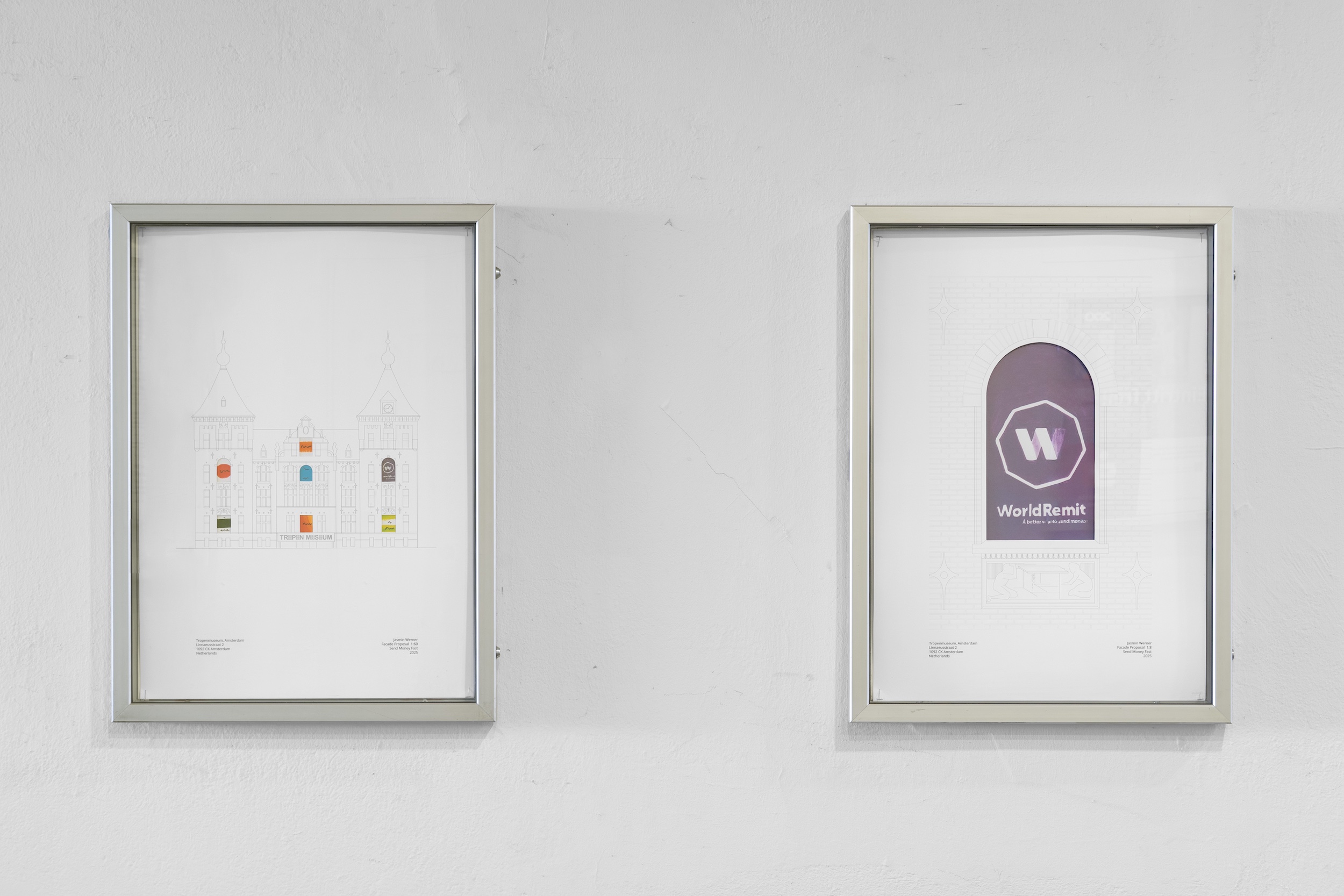
In the poster frames, Jasmin Werner presents proposals for modifying the building facades of existing museums. While the overall views of the museum facades remain unchanged, detailed drawings of individual window shutters feature hand-painted advertisements for money transfer services. In this way, prestigious architecture is brought face to face with the contemporary and everyday consequences of the extractive practices that are directly and indirectly linked to the collections inside their walls. As sites of memory, knowledge, and representation, museums are spaces where claims to power, ownership structures, and self-perception are negotiated and shaped. The facade proposals and window designs thus represent the framework of architecture and memory politics underpinning the global social conditions that have given rise to Ria, Western Union, MoneyGram, and co.
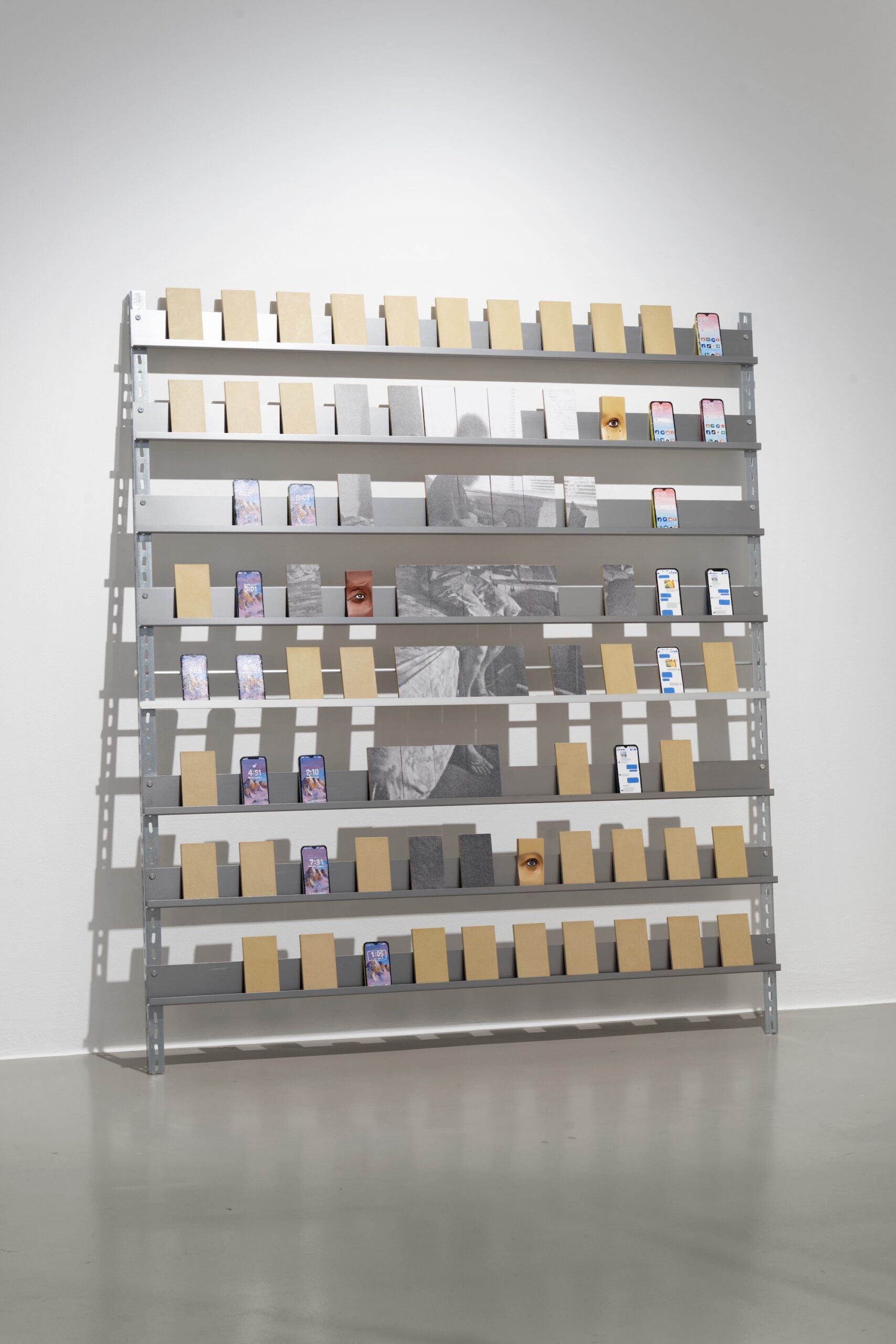
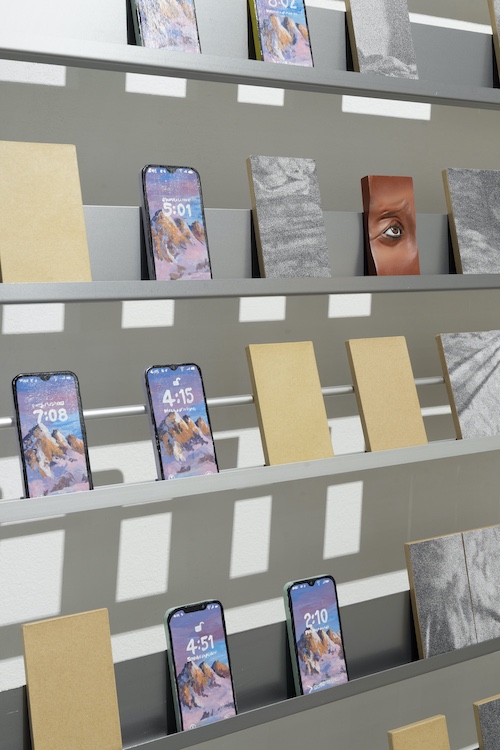
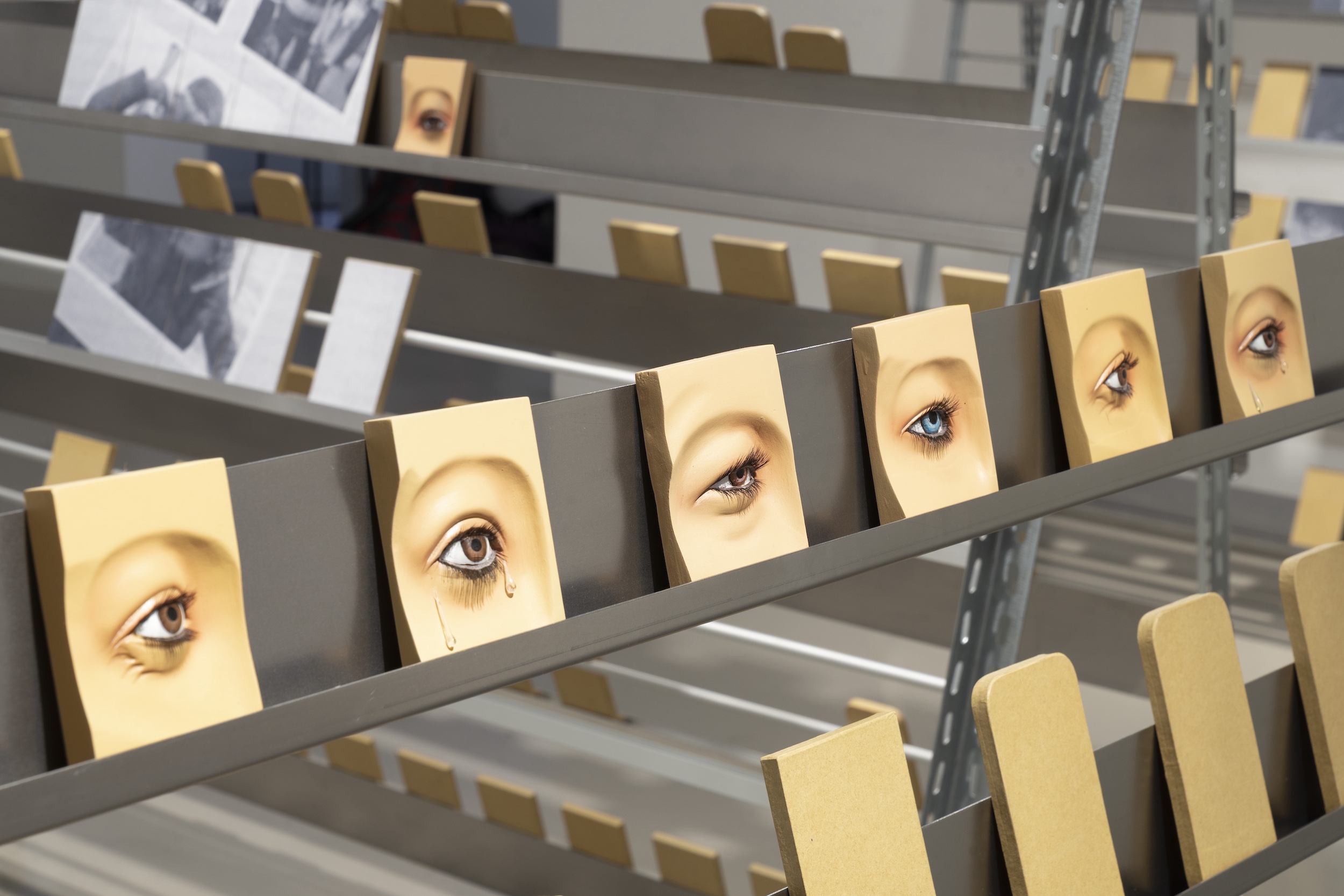
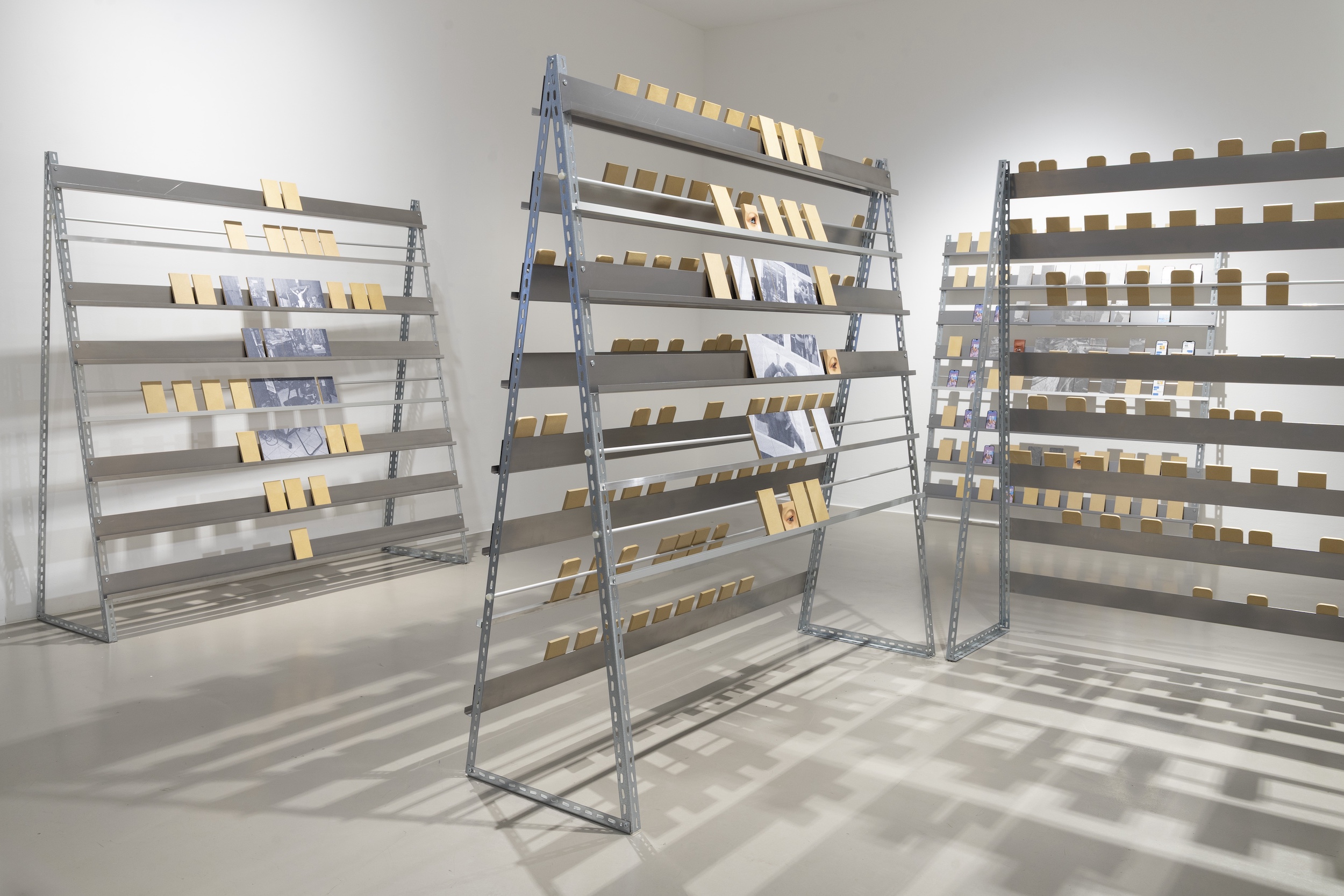
Werner’s indoor installation is a collection of shelving structures bearing papier-mâché replicas of cell phones. The multi-part work alludes to the shadow industry of so-called click farms, which are widespread throughout the Philippines. At these click farms, people move between similar shelving systems to continuously operate cell phones, click links, and give likes, thus generating revenue and exposure that they themselves receive little benefit from. Some of the papier-mâché cell phones in Werner’s installation are plain, some display home screens or chat histories, and others are hand-carved and gaze out from the shelves as three-dimensional eyes. They embody ritual and religious references while simultaneously negotiating proximity and distance. Cell phones and digital communication are often the only way for diasporic workers to maintain contact with their loved ones and their homeland.
Between the claims to ownership and power relations addressed in the works, real human relationships and memories are all too easily forgotten or overwritten—such as the memory of the historical foundations that created the current low-paid working conditions in the Philippines, or how the collections of the Tropenmuseum in Amsterdam and the Überseemuseum in Bremen came to be established. While the prestigious museum buildings occupy central locations in cities, money transfer services are mostly located on the outskirts. While objects from all over the world are readily welcomed, the global diaspora often receives significantly less acceptance. In her work, Jasmin Werner unites these parallel systems—which are closely linked but rarely visibly intersect—and challenges the logic of representation.
Representation is a format that allows memories of the past to influence the present. The memories that are kept alive in this manner are determined by the current needs of those remembering. Events are selectively included or excluded. What is represented is defined by our view of ourselves and the world. Our view of ourselves and the world, in turn, is shaped by representation. The title Structure of Claim is therefore open to interpretation. On the one hand, it refers to the clash between representation and the real living conditions of large swaths of the population. On the other hand, it also describes how Jasmin Werner subverts this logic by focusing on the fragility, tipping points, and instability of narratives, supposed truths, and value systems.
Opening: 10.10., 19:00
Exhibition view of Caught in a Landslide, Neuer Berliner Kunstverein (n.b.k.), 2025 © Photo: Neuer Berliner Kunstverein / Jens Ziehe
The series for fear of continuity problems invites artists to play a game of ping-pong between the small bookshop at the GAK and the question of how memory, perspectives, narratives, identities, and the unconscious can be spatially represented and publicly negotiated. Julia Horstmann has designed a new bookshelf for the collaborative project based on the idea of the memory palace, a method for remembering using places and artifacts.