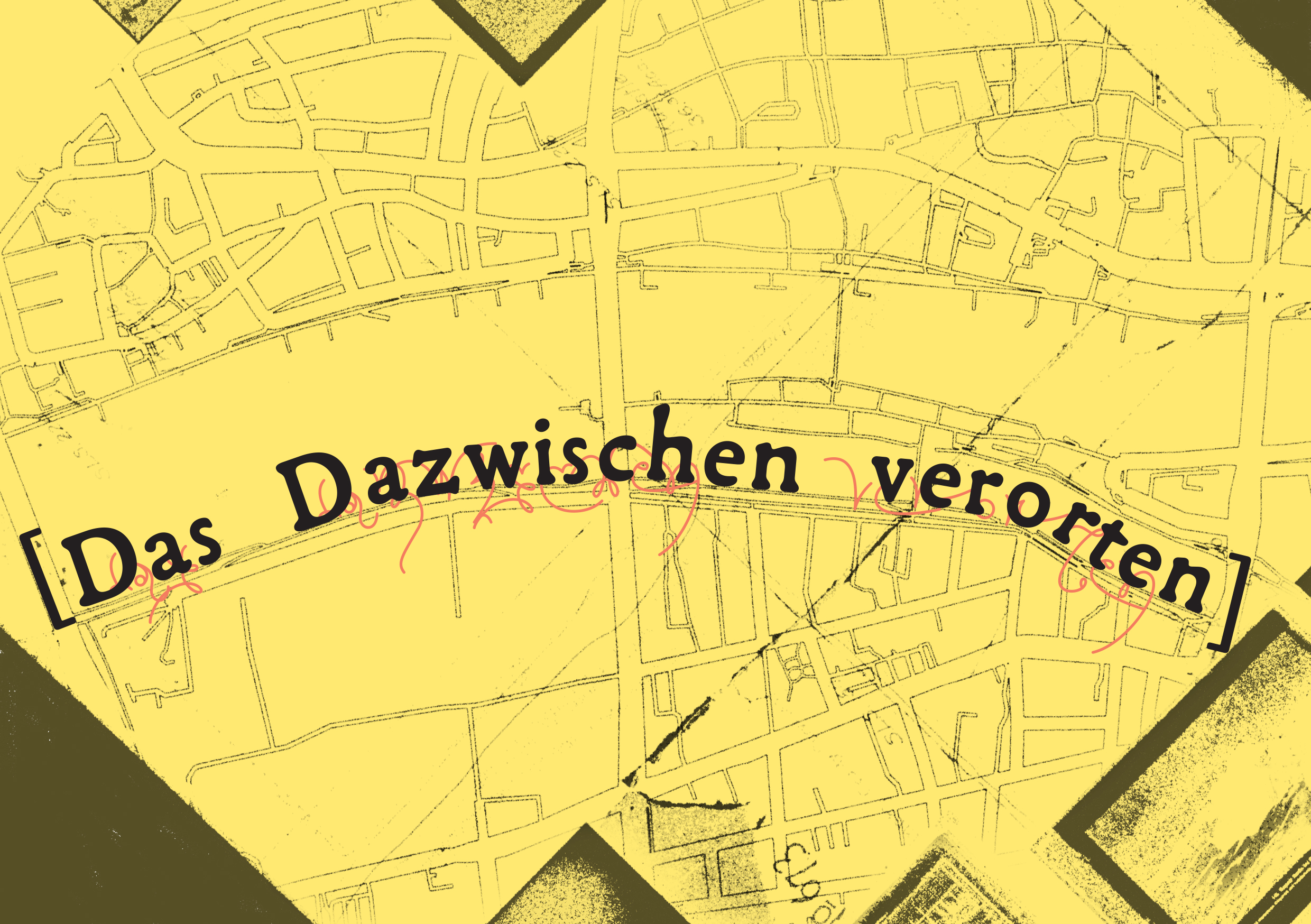
From September 11–13, [Das Dazwischen verorten] invites visitors to an artistic intervention along the left bank of the river Weser, which will undergo a fundamental redesign in the coming years due to flood control requirements. Through installation, painting, photography, sound and performances seven artists from Bremen and beyond explore the riverbank between Wilhelm-Kaisen-Brücke and Stephanibrücke, marking it as a site of transition.
For some, it is their daily commute to work; for others, it is the route to relaxing by the Werdersee; for local breweries and factories, it has been a site of production, delivery, and the shipping of goods for centuries; for the plane trees and birds, it is a contested habitat—the urban space is shaped by many different presences.
Due to rising water levels and new flood protection requirements, the section of the left bank between the Piepe and Stephanibrücke will soon go through significant changes. Before this redesign begins in 2028, [Das Dazwischen verorten] comments and marks this time of transition by focusing on what is already here and imagining what might be in the future. Works that are on view all weekend will be accompanied by a program of walks, performances, and activities.
Amy Balkin’s text-based work calls on visitors to walk along the path, to observe, and collect natural debris, and then return these findings to the river. She asks, what moments of threat and contradiction will emerge from this area, both in the present and in the future? In her artistic practice, Balkin investigates societal imprints on the landscape and in public space.
Together with Felisha Carénage, we will embark on a sound walk along the riverbank. Drawing on field recordings made in Trinidad and Tobago, where building construction has adapted to both rainy and dry seasons, Carénage’s work envisions scenarios for the future along the Weser.
In his painting practice, eghbal joudi explores the temporality, disappearance, and superimposition of (media) images. Placed on the stones of the Weser shoreline, the water alters his paintings. Depending on the tide, different sections of the work become visible; some details are washed away, while others remain intact.
Zhenru Liang often creates site-specific installations that incorporate collective relationships and differing temporalities. She marks this stretch along the Weser as a site of transformation—symbols drawn in chalk suggest that something is about to change. While urban signs usually convey clear instructions, Liang’s symbols invite speculation about what will disappear and what will develop here.
In a sound work and a series of photographs, Angela Lieber intertwines the transformation of place with processes of physical change. Lieber regularly works with text, sound, and performance, among other media, to examine affective states such as memory, longing, and desire.
Bubu Mosiashvili presents sculptures reminiscent of the information signs found in botanical gardens; his signs allude to the giant hogweed plants that have taken root along the riverbank. In Germany today, they are classified as an invasive plant species. Mosiashvili explores their status as criminalized neophytes in relation to their past significance as colonial-botanical ornamental plants and in an environment shaped by colonial history.
Julija Paškevičiūtė creates landscape-like installations that explore themes of temporary community and mutual appreciation. In the immediate vicinity of the local breweries, she has shaped small objects out of spent grain—a by-product of beer production—and during two participatory activities she invites visitors to collectively reflect on material transformation and sustainability.
While construction and design projects for the city must indeed comply with functional requirements and practicalities, [Das Dazwischen verorten] focuses on the draft stage. Through speculative formats and the temporary presence of objects, forms, and images, we seek to sharpen the focus on public space and build on that by reflecting on the possibilities of transformation and cohabitation.
Curated by Maxie Kiwitter
as part of Recurrencies I draußen
Duration of the exhibition
Friday, September 11 16:00 – Sunday, September 13 20:00
Events
Fri, 11.9.
19:00 Opening
19:15 Sound Walk with Felisha Carénage
Sat, 12.9.
14:00 Tending to … with Julija Paškevičiūtė
15:00 Performance by Zhenru Liang
Sun 13.9.
13:00 Tending to … with Julija Paškevičiūtė
14:00 Performance by Zhenru Liang
17:00 Joint walk
Funding
Der Senator für Kultur der Freien Hansestadt Bremen; Beirat Neustadt, Freie Hansestadt Bremen; Bremische Volksbank Stiftung